
India's current account slipped into a deficit of $9.6 billion or 1.3 per cent of GDP in the September quarter, the Reserve Bank said on Friday. The current account, which records the value of exports and imports of both goods and services along with international transfers of capital, was in a surplus mode both in the quarter-ago and year-ago periods. India's current account surplus had stood at $6.6 billion or 0.9 per cent of GDP in the April-June 2021 quarter, while in the year-ago period (Q2FY22), the surplus had stood at $15.3 billion or 2.4 per cent of the GDP, the data said.

The latest attachment order was issued by the central probe agency against Ms PD Agroprocessors Pvt Ltd, one the defaulters at the bourse.

Armed with necessary macro and micro growth drivers, India is on its way to becoming the fastest growing major economy in the world, a finance ministry report said. Rapid vaccination and teeming festivities will push India's ongoing recovery resulting in narrowing of demand-supply mismatches and greater employment opportunities, as per the monthly Economic Review prepared by the ministry.

'Higher than expected inflation in the US or the European Union, faster than expected tightening by the major central banks, break out of a war in Europe, and withdrawal of portfolio equities from the emerging markets are factors which can result in equity market corrections.'
However, the RBI is still not in a mood to issue an OMO calendar, which was the expectation in some sections of the market.

'Long-term retail investors should not worry about these sharp dips and jumps if they have chosen their stocks wisely.' 'Short-term volatility is a given and a rise and fall of two-three per cent should not worry them.'

'... as has been happening in the last three weeks, then the foreign exchange reserves will not be comfortable to ensure that the rupee does not fall drastically.'

Non-banking finance companies face renewed asset quality and liquidity risks amid a second wave of COVID-19, Fitch Ratings said on Thursday. These challenges are likely to increase if recent restrictions to contain the pandemic are expanded or prolonged, leading to greater economic and operational disruption, it added. The rating agency further said that an increase in the rate of infections and broadening of social distancing restrictions pose downside risks to its 12.8 per cent growth projection for the current fiscal.

Second-tier NBFC stocks are trading at 24.4x their trailing earnings, which is nearly twice their 15-year average of 13.9x

India's current account deficit is expected to deteriorate in the current fiscal on account of costlier imports and tepid merchandise exports, according to the Finance Ministry's monthly economic review. The review released on Thursday by the ministry also said that global headwinds would continue to pose a downside risk to growth as crude oil and edibles, which have driven inflation in India, remain major imported components in the consumption basket. For the present, it said, "their global prices have softened, as fears of recession have dampened prices somewhat. This would weaken inflationary pressures in India and rein in inflation."


After opening higher, the markets continued to trade in the positive zone in the afternoon session as traders were encouraged by RBI governor Shaktikanta Das's statement that the new resolution framework is expected to give durable relief to borrowers amid the Covid-19 crisis, said Narendra Solanki, head-equity research (fundamental), Anand Rathi.
The wider NSE Nifty too ended 21.55 points, or 0.21 per cent down at 10,476.70.

Finance minister Nirmala Sitharaman on Wednesday exuded confidence that inflation would further decline and the government is on track to meet its budgetary target for deficit and said that there is no fear of stagflation in India. Replying to the debate on first batch of Supplementary Demands for Grants 2022-23 in Lok Sabha, the finance minister said inflation has come down and it is now in the tolerable band of the RBI. Inflation has been declining since April 2022 and it is declining further, she said.

To select the right platform, get the opinions of a few existing users or browse online for feedback. Select a platform that offers a seamless experience. Check that the platform you are going with is a regulated entity, suggests Sanjay Kumar Singh.

The NSE Nifty, after shuttling between 10,331.80 and 10,227.45, finally settled 196.75 points, or 1.94 points higher at 10,325.15.

As the voting process for the new Conservative Party leader formally opened with postal ballots being mailed out to Tory members from Monday, Rishi Sunak vowed to cut the basic rate of income tax by 20 per cent in a few years if he is elected Britain's prime minister.

We will find it difficult to exceed an average of 5 per cent growth in the medium term, warns Shankar Acharya, the former chief economic adviser.

A delayed monsoon and abundant cotton in the international market could spell trouble in the state's suicide zone.
India's current account swung to a deficit for the first time in the current fiscal, with the gap coming at $1.7 billion or 0.2 per cent of the GDP in the December quarter. In the current fiscal, as the pandemic impacted trade, the current account had been in surplus in the previous two quarters, at $15.1 billion and $19 billion, respectively, as per the data on balance of payments released by the RBI on Wednesday. The critical measure of a country's external strength now stands at a surplus of 1.7 per cent of GDP for the first nine months of the fiscal year as against a deficit of 1.2 per cent in the year-ago period. In the December quarter, there was a rise in the merchandise trade deficit to $34.5 billion from $14.8 billion in the preceding quarter, and an increase in net investment income payments.

Senior bankers are trying to impress upon the central bank that the shift to external benchmark-linked lending be postponed to April 1, 2020.

For development finance institution to succeed now, the government must stand like a rock behind it and be patient.

The currency market won't care for our moans, groans, cries and sighs. The rupee will find its own level, explains Tamal Bandyopadhyay.

'This is the first time we will see how SIP investors react to market correction.'
According to the complaint filed by SBI, the account had become non-performing asset on January 27, 2016.

'Rohit had so much talent that he would have made it anyhow, under any coach, but I am happy I was able to guide him.'

...but when they awaken, it's going to be overly optimistic to assume everybody will walk off the sleeping bed and come back to full life, Rajan noted.

'Willing to spend is different from when to spend and how much to spend'

While the likely intensity of the third wave is still a matter of debate, wisdom lies in being financially prepared for it, advises Bindisha Sarang.

The Supreme Court has refused to interfere with the government and RBI's loan moratorium policy, and declined to extend the six-month loan moratorium period.

'India's sizeable foreign exchange reserves should serve as a buffer.'

Sun Pharma was the top gainer in the Sensex pack, soaring around 6 per cent, followed by Kotak Bank, Axis Bank, IndusInd Bank, ICICI Bank, Dr Reddy's, Titan and TCS. NSE Nifty surged 121.35 points to 14,617.85.

The 50-share Nifty scaled a high of 10,207.90 intra-day but succumbed to profit-booking to finish at 10,184.15, up 53.50 points

Every patriot should learn from our history and recognise that celebrating size will neither negate nor obscure the huge economic challenges that India faces, asserts Rathin Roy.

Reserve Bank of India Governor Shaktikanta Das on Friday said the central bank will ensure adequate liquidity in the system to ease the financial stress caused by the Covid-19 pandemic. The central bank reduced the reverse repo rate -- the rate at which banks park their fund with the central bank -- by 25 basis points to 3.75 per cent.

The National Commission ruled that a person must opt for a policy and submit the proposal form after acquainting himself with the terms and scope of coverage to determine where it would be suitable and adequate.
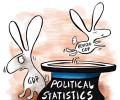
The brokerage said the consolidated fiscal deficit, including that of the Union (3.6 per cent), the states (2.6 per cent) and the off-budget borrowings which are being resorted to increasingly is a worry.

There is widening gap between what the government's premier retirement fund makes on its investments and what it offers to employees. The Employees' Provident Fund Organisation (EPFO) makes the bulk of its investments in government-related securities. In other words, it lends to central and state governments and related entities. The interest it gets from these instruments is largely what it uses to pay interest to its subscribers.

'The government is encouraging consumption through fiscal spending in a bid to push up economic growth in the face of a slowdown in corporate investment and exports.'

A direction by Chief Justice of India S A Bobde, Justice B R Gavai, and Justice Surya Kant to the Karnataka high court asked the latter to expeditiously settle the matter of assets deposited before it by Mallya for liquidation, and thereby payment to creditors 'preferably not later than three months'. It will be interesting to see the view of the London high court, if the settlement of his dues to Indian creditors is imminent, reports Ashis Ray.
 © 2026 Rediff.com - Advertise with us - Disclaimer - Privacy Policy - Sitemap - Feedback - About us - Terms of use - Grievances